
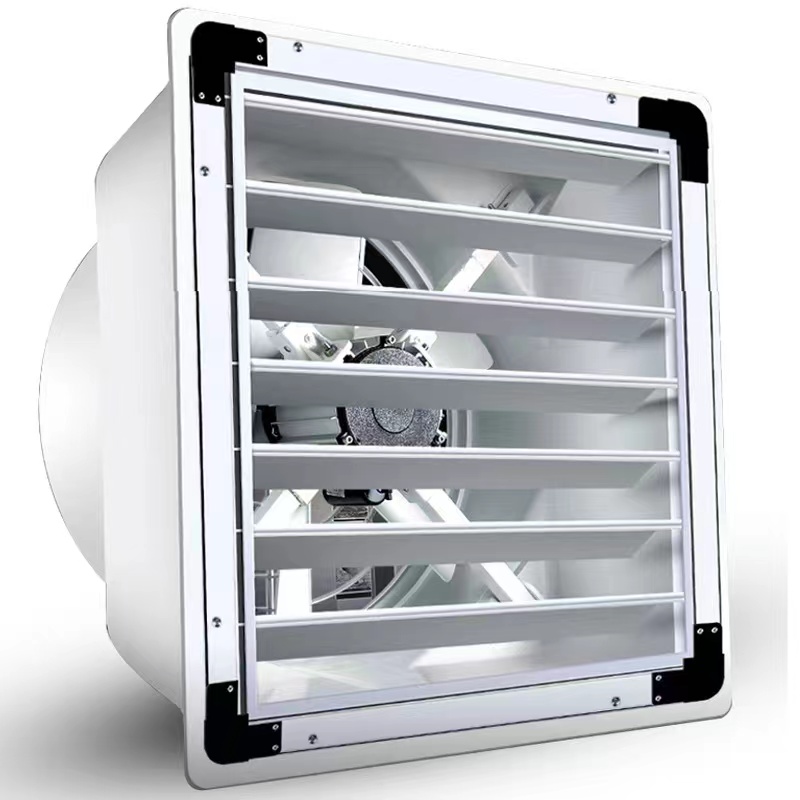
Optimizing Airflow: Technical Insights into PVC Gravity Louver Design for Industrial Ventilation
Efficient ventilation is a fundamental requirement in industrial facilities, directly affecting equipment reliability, workplace safety, and energy consumption. In environments such as chemical plants, manufacturing workshops, power facilities, and wastewater treatment stations, ventilation systems must operate reliably under harsh conditions while maintaining stable airflow performance.
Among various passive ventilation components, the PVC Gravity Louver has become an increasingly preferred solution for industrial ventilation engineers. Its simple mechanical structure, corrosion resistance, and energy-free operation make it especially suitable for environments where reliability and maintenance efficiency are critical.
This article provides a technical analysis of PVC Gravity Louver design, focusing on airflow efficiency, blade geometry, opening pressure calculations, and performance advantages in corrosive industrial environments.
1. The Role of Gravity Louvers in Industrial Ventilation Systems
Gravity louvers are non-powered airflow control devices designed to regulate intake or exhaust air automatically. Unlike motorized dampers, they rely on pressure differentials generated by airflow to open and close.
In industrial ventilation systems, gravity louvers serve several core functions:
- Prevent backflow when ventilation fans are inactive
- Protect equipment and interiors from rain, dust, and debris
- Maintain directional airflow without energy consumption
A PVC Gravity Louver fulfills these functions while offering additional advantages in chemical resistance and lightweight construction compared to metal alternatives.
2. Airflow Efficiency: Why Design Parameters Matter
Ventilation efficiency is not determined solely by fan capacity. The resistance created by airflow components—including louvers—plays a decisive role in overall system performance.
Poorly designed louvers can significantly increase pressure loss, reducing airflow volume and increasing energy consumption. Therefore, the design parameters of a PVC Gravity Louver must be evaluated carefully during system planning.
Key parameters affecting airflow efficiency include blade angle, blade spacing, opening pressure, and material surface characteristics.
3. Blade Angle and Its Impact on Airflow Performance
Blade angle is one of the most critical design elements in a gravity louver system.
3.1 Relationship Between Blade Angle and Airflow Resistance
The blade angle determines how easily air can pass through the louver when open. A steeper blade angle may improve weather protection but increases airflow resistance. Conversely, a shallower angle allows higher airflow but may compromise backdraft prevention.
In industrial ventilation design, the optimal blade angle balances:
- Low pressure drop during operation
- Reliable closure when airflow stops
- Adequate protection against external elements
A well-engineered PVC Gravity Louver typically uses blade angles optimized through airflow simulation and field testing.
3.2 Blade Overlap and Sealing Performance
Blade overlap affects how effectively the louver prevents reverse airflow. Excessive overlap can restrict airflow, while insufficient overlap may allow leakage.
PVC materials allow precise extrusion profiles, enabling consistent blade geometry and improved sealing performance without increasing weight.
4. Opening Pressure: A Critical Performance Indicator
Opening pressure refers to the minimum air pressure required to move the louver blades from a closed to an open position. This parameter directly influences ventilation system responsiveness.
4.1 Calculating Opening Pressure in Ventilation Design
From an engineering perspective, opening pressure depends on several variables:
- Blade weight and material density
- Pivot design and friction resistance
- Blade surface area exposed to airflow
One advantage of using a PVC Gravity Louver is the material’s low density. Compared to metal blades, PVC blades require lower airflow pressure to open, which improves ventilation efficiency—especially in low-pressure systems.
4.2 Matching Opening Pressure to Fan Performance
If the opening pressure is too high, the louver may not open fully, restricting airflow. If too low, blades may flutter under variable airflow conditions.
Proper matching of louver opening pressure to fan specifications is essential in industrial ventilation system design.
5. Surface Characteristics and Airflow Stability
The surface finish of louver blades also affects airflow behavior. Rough or corroded surfaces create turbulence, increasing resistance and noise.
PVC offers a naturally smooth surface that remains stable over time. Unlike metal louvers, which may corrode or oxidize, a PVC Gravity Louver maintains consistent airflow characteristics throughout its service life.
This stability is particularly valuable in precision ventilation systems where predictable performance is required.
6. Performance Advantages in Corrosive Industrial Environments
One of the most compelling reasons for selecting a PVC Gravity Louver is its superior resistance to corrosive environments.
6.1 Chemical Resistance in Industrial Applications
In chemical plants, laboratories, and wastewater treatment facilities, ventilation components are often exposed to:
- Acidic or alkaline vapors
- High humidity and condensation
- Chemical aerosols and fumes
PVC materials demonstrate excellent resistance to a wide range of acids, alkalis, and salts, making them suitable for long-term use without surface degradation.
6.2 Longevity Compared to Metal Louvers
Metal gravity louvers, even when coated, are vulnerable to corrosion over time. Corrosion increases blade weight, friction, and airflow resistance, leading to reduced system efficiency and higher maintenance costs.
A PVC Gravity Louver, by contrast, offers stable mechanical performance and extended service life in aggressive industrial environments.
7. Lightweight Design and Structural Benefits
Weight is often overlooked in ventilation component selection, yet it has a direct impact on installation and system performance.
PVC gravity louvers are significantly lighter than steel or aluminum alternatives. This results in:
- Lower opening pressure requirements
- Reduced structural load on mounting frames
- Easier installation and handling
For large-scale industrial projects, these benefits translate into reduced installation time and improved system reliability.
8. Maintenance Efficiency and Operational Reliability
From a facility management perspective, maintenance requirements are a key consideration.
PVC gravity louvers offer:
- No need for lubrication
- Resistance to rust and scaling
- Minimal blade deformation over time
These characteristics reduce downtime and simplify routine inspections, making PVC Gravity Louver systems well-suited for continuous industrial operation.
9. Application Scenarios in Industrial Ventilation
PVC gravity louvers are commonly used in:
- Chemical processing plants
- Industrial exhaust and intake systems
- Power generation facilities
- Wastewater treatment stations
- Manufacturing workshops with corrosive emissions
In these applications, consistent airflow control and corrosion resistance are more critical than aesthetic considerations.
10. Partnering with a Professional PVC Gravity Louver Manufacturer
The performance of a gravity louver system depends not only on design theory but also on manufacturing precision and material quality.
Dongguan Shangyu Plastic Hardware Products Company Limited is located in Dongguan City, Guangdong Province, China—an internationally recognized manufacturing hub with convenient access to Hong Kong and Guangzhou.
We are a professional manufacturer of PVC plastic extrusion products, including PVC Gravity Louvers, PVC pipes, PVC profiles, PVC shutters, and PVC road barriers. Our production capabilities include in-house mold development based on customer drawings or samples, supported by independent design, engineering, quality control, and sales teams.
By using dual-screw extrusion machines that extrude directly from PVC powder, we eliminate the granulation process. This allows us to control costs effectively while ensuring fully plastified, high-performance products.
With over 10 years of industry experience among our key technical personnel, we focus on delivering customized solutions that meet specific requirements such as UV resistance, aging resistance, corrosion resistance, flame retardancy, and impact strength.
We support OEM and ODM projects and have supplied PVC extrusion products to customers in America, Japan, the European Union, and other global markets. Through stable quality, reasonable pricing, and reliable after-sales service, we aim to be a long-term partner for industrial ventilation and infrastructure projects worldwide.